

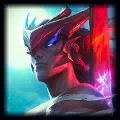
Yone
Mid Build, Runes, Items · Patch 26.9





















Starting Items


Build Order


Completed Items


Situational Items


Best Matchups

Worst Matchups



Best Synergy






More Synergy


Overview
Yone is one of the most unique skirmish assassins in League of Legends, built around a dual-form passive that creates a fundamental safety mechanism no other champion possesses. When Yone activates his E, Soul Unbound, his physical body stays behind while his spirit form dashes forward — and when the ability ends or he reactivates it, he snaps back to his body's location, making the engage inherently reversible. This means Yone can dive into the middle of the enemy team, deal significant burst damage, and return to safety in a way that most divers and assassins simply cannot. His Q, Mortal Steel, fires a wind slash that deals physical damage and can be charged to knock enemies up, while his W, Spirit Cleave, deals both physical and magic damage simultaneously. His ultimate, Fate Sealed, teleports Yone behind a target line of enemies and strikes them all, making it one of the most powerful multi-target engage ultimates in the game. He is mechanically demanding but rewards players who understand his engage windows with the ability to threaten carries without fully committing to death.
Strengths
- Soul Unbound E provides a built-in safety mechanism that makes Yone's dives inherently reversible — he can enter the enemy team, deal damage, and return to his body's position, making him significantly harder to trap than most melee assassins
- Fate Sealed ultimate teleports behind multiple enemies simultaneously and strikes them all, providing one of the most reliable multi-target engage tools in the game that can instantly group enemies for follow-up from his team
- Dual damage type from W makes Yone difficult to itemize against — building armor reduces his physical damage but not his magic damage, and building magic resistance does the opposite
- Strong scaling with attack speed items means Yone becomes increasingly dangerous as the game progresses, with Legend: Alacrity and Lethal Tempo combining to reach attack speeds that make him difficult to trade with in extended fights
- High outplay potential through E's reversal mechanic — experienced Yone players can use Soul Unbound to bait enemy crowd control and abilities, then return to their body after those abilities have been wasted
Weaknesses
- Hard crowd control during Soul Unbound is extremely punishing — a stun or knockup that lands while Yone is in spirit form prevents him from dealing his full damage and can result in his death before he returns to his body
- Early game is his weakest phase — before items and levels, his damage is insufficient to threaten most lane opponents and he must play conservatively to avoid giving early kills that delay his scaling
- Overcommitting with E is one of the most common Yone mistakes — diving too deep into a fight without an escape angle, or timing the return badly into a group of enemies, results in dying before the safety mechanic can save him
- Fate Sealed requires positioning behind the enemy line — if Yone is in a position where the teleport destination places him inside the enemy team rather than behind retreating targets, the ultimate can backfire and leave him surrounded
- Kite-heavy compositions with slows and long-range damage can prevent Yone from reaching targets even with E — a team built around keeping him away can effectively negate his melee threat before Soul Unbound even reaches its targets
Early Game
Yone's early game is the most important phase to survive without giving kills, because his item scaling and level advantages compound dramatically once he gets his first power spike. His Q Mortal Steel is your primary lane tool — use it to poke the enemy laner and last hit simultaneously, and charge it to the knockup when the enemy steps forward to farm. Avoid using Soul Unbound aggressively before level six unless the enemy has already used their escape ability or crowd control, because a failed E dive that results in death sets his power spike timeline back significantly. Play around short trades where Q and W together deal enough damage to win the exchange, then disengage before the enemy can follow up. Use Second Wind's healing to stay healthy through poke-heavy matchups. At level six, your ultimate provides a much safer engage tool — look for the first opportunity to use Fate Sealed on an overextended enemy to demonstrate your kill threat and force the enemy to play more cautiously.
Mid Game
Mid game is where Yone's engage potential begins paying dividends across the entire map. With his first core item and level advantage over side laners, his burst damage in short skirmishes becomes genuinely threatening to most champions who do not have strong peel or crowd control. The most important mid game habit is identifying which lane has the most vulnerable target — an ADC farming alone, a support rotating carelessly, or a mid laner who has overextended without vision. Use Soul Unbound to approach from an angle the enemy does not expect, deal the burst Q plus W plus auto attack chain, and return to your body safely. In objective fights around Dragon and Rift Herald, save your ultimate for the moment multiple enemies are grouped near the objective entrance — a Fate Sealed that hits three or four enemies simultaneously sets up an instant fight win before it has properly started. Position yourself near the flank before the fight begins so your teleport destination places you behind retreating enemies rather than in the middle of their formation.
Late Game
Late game is where Yone's scaling reaches its peak and where his ultimate becomes the most impactful ability in any teamfight. With full items and Lethal Tempo stacking quickly, his damage in extended fights is genuinely difficult to survive for squishy targets. In five-on-five teamfights, the fundamental discipline is to never use Soul Unbound without a clear return path — identify where your body will be when E ends before you activate it, because a bad return position can place you inside the enemy team with no escape. The ideal late game play is to flank from an unexpected angle, use Fate Sealed to teleport behind the entire enemy backline, and return to your body which is now safely outside the fight while your team follows up on the enemies you grouped. Save Fate Sealed for the moment when the most valuable backline targets are lined up — a perfect ultimate that hits the enemy ADC and mid laner simultaneously is often enough to instantly decide the game's most important fight.
Tips & Tricks
- Always know where your body will be when Soul Unbound ends before you activate E — the return position is determined the moment you cast it, so positioning your body in a safe location before diving is the most important habit to develop on Yone.
- Mortal Steel Q charges stack — use Q once to apply the projectile, then use it again after the stack charges to release the knockup. The knockup applies even if the initial Q did not hit, so landing the charged version on an already-poked enemy is a reliable setup for a full combo.
- Fate Sealed teleports Yone behind the last enemy in the line — aim it through the enemy backline so the teleport places you behind the enemy ADC or mid laner rather than behind the tank or frontline champion who is standing at the front.
- Soul Unbound can be used as both engage and disengage — if an assassin jumps on you, activate E to create distance while dealing damage, then return to your body once you have created enough space that the return position is safe.
- Legend: Alacrity stacks on takedowns — prioritize participating in kills and assists throughout the game to build stacks, because maximum Legend stacks combined with Lethal Tempo make Yone's attack speed in late game fights genuinely oppressive.
For official ability details and lore, visit the official Yone page and the Yone Wiki.